

 OMG Nepal
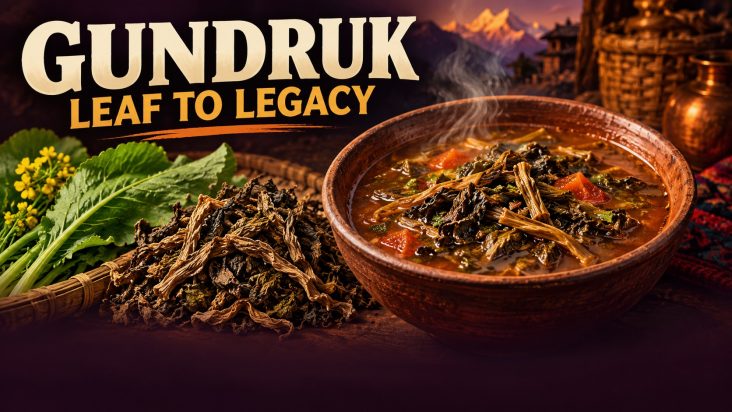
A few leafy greens might seem an unlikely starting point for a story about Nepal’s ingenuity. Gundruk offers a reason to look again. Fermented and then dried, these leaves connect an everyday food tradition with a fascinating scientific question: what happens when microorganisms help transform the harvest?
The transformation inside the leaves
The Food and Agriculture Organization’s account of gundruk describes the use of leafy vegetables such as mustard, radish and cauliflower. Fermentation comes before sun-drying, and the resulting food is served alongside a meal or as an appetiser.
In the process described by FAO, the leaves are fermented without added salt. Its technical account identifies lactic-acid bacteria, including Lactobacillus and Pediococcus, as important participants, and describes increasing acidity during fermentation. The sour character has a microbial explanation.
This is a useful way to appreciate the craft: the leaves are not simply being dried in a different shape. Fermentation changes them before drying takes place.
Why gundruk is also a research question
A 2026 paper in the Journal of Microbiological Methods examines microbial diversity in gundruk and the use of lactic-acid bacteria as starter cultures. According to its abstract, the researchers aimed to make taste, flavour and quality more consistent between batches.
The abstract describes preparations using mustard, rapeseed and cauliflower leaves, with comparisons of microbial and chemical characteristics during fermentation. Our discussion here is limited to that published abstract; it does not establish that every household batch will behave in the same way.
For a reader, the interesting question is straightforward: how can researchers understand a familiar food more closely while respecting the knowledge of the people who make it?
A different kind of Nepali heritage
The story of gundruk is a good reason to widen our idea of heritage. Alongside buildings and objects, consider the practical knowledge involved in taking an ingredient through a transformation. There is room for both a laboratory question and a kitchen conversation.
If you already know gundruk, ask someone who makes it what they pay attention to. If it is new to you, ask how it is prepared and served before choosing it. Let the food lead to a conversation rather than a competition over a single correct version.
Celebrating Nepal can begin with something this modest: paying closer attention to a leaf, a process and the knowledge behind a familiar meal.
Related OMG Nepal reading
- Take a look at our classic Nepali dishes, gundruk and dhido.
- Nepali Dishes You Need to Try at Least Once
Sources
- https://www.fao.org/4/x0560e/x0560e11.htm
- https://www.sciencedirect.com/science/article/abs/pii/S0167701226000862
Image: Editorial food illustration; a conceptual serving, not a documentary photograph or step-by-step recipe. Cover illustration: OMG Nepal.