

 OMG Nepal
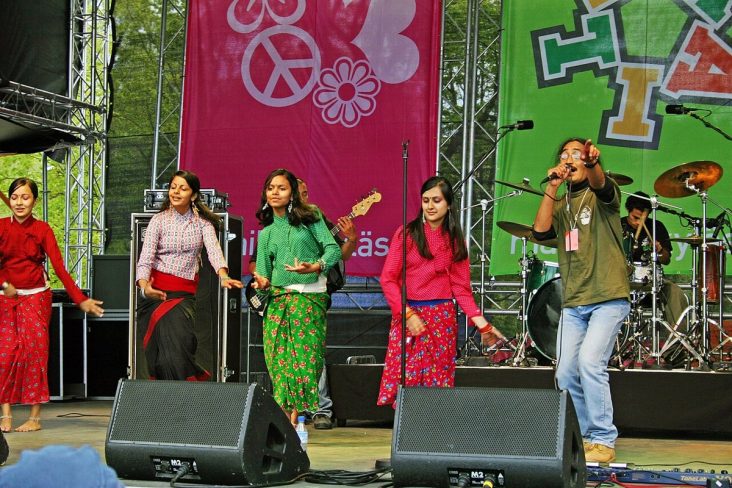
Amrit Gurung performing at the World Village festival in Helsinki, May 2006. Archival performance photograph.
A song can carry a place without describing every hill or street in it. Nepathya’s enduring creative idea is to let folk melodies travel inside a contemporary band. A listener may arrive for the energy of the music and stay for the sense of a country sounding through it.
The folk melody at the centre
The band’s own history identifies Deepak Rana, Bhim Poon and Amrit Gurung as its founders in 1990. It describes folk music as central to Nepathya’s sound and Gurung’s travels and research as part of the work behind that connection.
The official account also traces changes in the musicians around the band over time. Continuity, in that telling, means a musical identity sustained through changing collaborators. It is a useful way to hear a long-running group: as a body of work shaped by people arriving, contributing and moving on.
The blend has a clear attraction. A folk melody can remain recognisable while a band gives it another setting. That meeting offers listeners several ways into the same song, whether they first notice the rhythm, a familiar phrase or the voice.
Choose a recording and follow the thread
Nepathya’s official discography gives curious listeners a route through that history. Albums including Resham, Bhedako Oon Jasto, Ghatana, Mero Desh and Aina Jhyal provide starting points for exploring different periods of the catalogue.
Rather than treating a playlist as a race through the most recognisable titles, try listening to a small selection twice. On the second pass, pay attention to how a voice enters, how the instruments support it and what stays in memory. No lyric sheet needs to be reproduced to share that experience; a link to the band’s authorised recordings takes listeners to the music itself.
The band also lists a biography by Girish Giri, Nepathya: Lokpriya Yatrako Antaranga. Its official book page describes a 356-page volume. For listeners drawn to the people and decisions behind a performance, the existence of that longer account is an invitation to go deeper.
A living part of the culture
Promoting Nepali culture through music is most interesting when the music gets to remain alive: performed, rearranged, argued about and discovered by someone new. A band’s work does not need to stand for every community or every sound in Nepal to open a door.
Nepathya opens one such door. Follow the catalogue, look for the musicians’ own accounts and give a song enough time to become more than background sound. The country in the music is worth listening for.
From the OMG Nepal archive: Traditional Music Instruments of Nepal.
Sources and further reading
Sources checked October 6, 2026. Event details may change; historical dates are stated in the story.
- Nepathya: official band history
- Nepathya: official discography
- Nepathya: Girish Giri’s band biography
Cover photo: Amrit Gurung Nepathya helsinki2006b.jpg by No machine-readable author provided. Mikael Korpela assumed (based on copyright claims). / Wikimedia Commons. CC BY-SA 3.0. Resized for web; thumbnail display may crop.