

 OMG Nepal
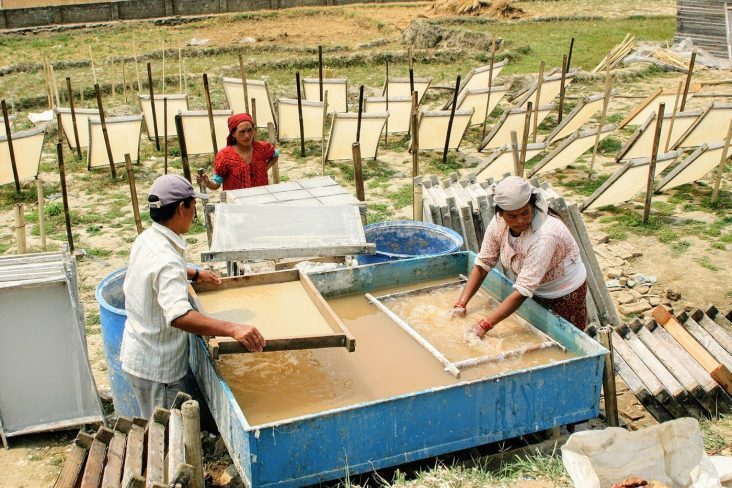
Lokta papermaking in Kathmandu in 2005. Archival craft photograph.
The textured cover of a lokta notebook is only the last part of its story. Nepal’s traditional handmade paper begins with the fibrous inner bark of a Himalayan shrub. Following that material back to its source reveals a connection between craft, forest management and the people whose work turns a plant into a useful sheet.
Bark becomes a working material
FAO’s account of Nepal’s handmade-paper industry identifies lokta as Daphne species and describes a chain of work extending from harvesting and papermaking to finished products and marketing. It treats paper as a livelihood activity linked to access to forest resources.
That is a richer starting point than calling a notebook simply natural or traditional. The material has to be gathered, processed and made into something durable enough to use. Each stage represents knowledge and labour that a finished souvenir can easily hide.
Renewable is not the same as unlimited
A historical project account from Manfred-Hermsen-Stiftung and ANSAB describes work with forest-user groups in Parbat. It connects the long-term income from lokta with careful management and identifies destructive harvesting among the threats to the resource.
The project’s pilot and later expansion belong to the 2000s. They are useful evidence of the management challenge, not proof that every lokta product on sale today has been sustainably sourced.
Ask a maker a more interesting question
When choosing paper, ask who made it and where the material came from. If a seller claims certification, request the relevant information instead of assuming that handmade automatically means certified.
You can also ask how the paper suits your intended use. A sheet for a print, a journal or gift wrapping may invite different choices of thickness and finish. Taking time over those details gives the craft a practical place in daily life.
The appeal of lokta is not limited to its surface. It is a material that asks us to connect an object with a landscape and with the work behind it. A notebook becomes more memorable when its story includes the forest as well as the page.
From the OMG Nepal archive: From Germany to Nepal: The Homecoming of Centuries-Old Manuscripts.
Sources and further reading
Sources checked October 26, 2026. Historical dates are stated in the story; announced event details may change.
- FAO — Nepal lokta paper value-chain case study
- Manfred-Hermsen-Stiftung — historical Parbat lokta project
Cover photo: Fabrication papier lokta.jpg by Gozitano / Wikimedia Commons. CC BY-SA 4.0. Resized and converted to JPEG for web; theme thumbnails may crop.