

 OMG Nepal
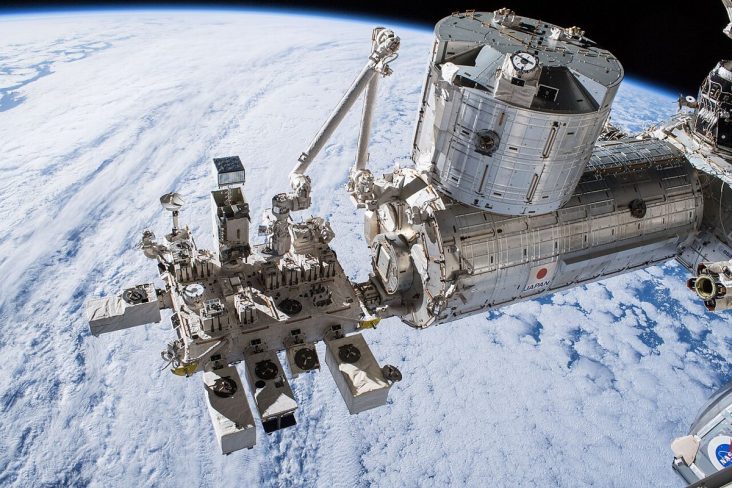
JAXA’s Kibo laboratory module on the International Space Station, photographed by NASA. Not the June 2019 satellite deployment.
Ten centimetres on each side is a surprisingly small space in which to place a national first. Yet that was the scale of the CubeSats developed for BIRDS-3, the international project that included NepaliSat-1. The box was small; the engineering challenge and the learning around it were much larger.
A precise date in Nepal’s space story
JAXA records that NepaliSat-1 was deployed from the International Space Station’s Japanese Kibo module on June 17, 2019. Nepal’s Academy of Science and Technology and Japan’s Kyushu Institute of Technology co-developed it. Satellites associated with Sri Lanka and Japan were part of the same BIRDS-3 group.
JAXA’s June 2019 account identifies NepaliSat-1 and Sri Lanka’s Raavana-1 as their countries’ first satellites. It describes an international programme in which participating teams developed a CubeSat over roughly twelve months.
That makes this a historical engineering feature, rather than a claim that NepaliSat-1 is a new launch or is still operating. The milestone deserves accurate dates as much as enthusiastic memories.
What a small satellite is for
JAXA’s deployment history lists the BIRDS-3 mission areas as short-message exchange, Earth observation, measuring Earth’s magnetic field and demonstrating communication technology. These were compact research and technology tasks, not a promise that one tiny satellite could transform every aspect of life on the ground.
The distinction helps explain the project’s significance. A small mission can make a real contribution by giving engineers experience with the entire chain: turning requirements into hardware, getting a payload ready for deployment and learning from what happens afterwards.
Working through that chain is different from simply admiring a finished technology. It places participants inside the discipline of building something that has to function under constraints. The scale of the satellite makes those constraints visible rather than making them trivial.
Put the makers in the picture
Space stories are usually illustrated by rockets. Nepal’s first-satellite story also belongs to the quieter images: a laboratory bench, components arranged for testing, or people comparing the result with what the design required.
For young readers, that is an encouraging way to approach science. Participation can begin with a bounded problem and a collaborative project. Learning to solve that problem is an achievement in itself, and it can support more demanding work later.
NepaliSat-1 gave Nepal a first entry in a spaceflight record. Its more lasting invitation is to take the engineering behind such entries seriously—to ask who learns, what they build and how the next team can begin with more knowledge than the last.
From the OMG Nepal archive: Nepal’s First Satellite NepaliSat-1.
Sources and further reading
Sources checked October 6, 2026. Event details may change; historical dates are stated in the story.
Cover photo: ISS-55 EVA-1 Kibo laboratory module.jpg by NASA / Wikimedia Commons. Public domain. Resized for web; thumbnail display may crop.